The Book Lender
B. Reuben
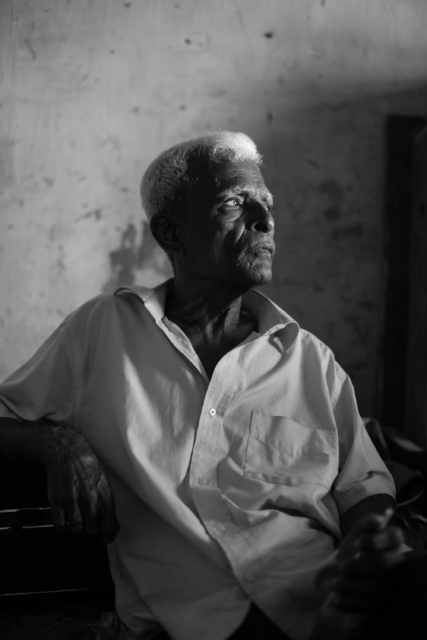
Mr Reuben, a former teacher from Pedlar Street in Galle Fort, is remembered by many of his former students, including doctors, lawyers and police officers who still show him quiet respect. He inherited a small lending library in 1958, once a meeting place for readers and political discussions. Although the library fell into decline after he was banished to Moneragala in 1978 for his leftist activities, Mr Reuben remains determined to revive it.
I met Mr Reuben through Sabri, who runs a guest house in the Galle Fort and had once been his student. A respected teacher, Mr Reuben taught many of the doctors, lawyers and professionals who grew up in the Fort. Even today, policemen who were once his students avoid smoking in his presence out of respect.
Across from his home on Pedlar Street is a tiny room filled with decaying books. Mr Reuben told me about the lending library he inherited in 1958 and the people who once gathered there. It was not only a place for readers but also a meeting point for political discussions linked to his former leftist party.
In 1978 he was banished to a remote village in Moneragala for what he described as his political activities. During that time the library fell into decline and many of its books were lost.
Despite this, Mr Reuben still hopes to revive the library and reopen the small space that once brought readers together. For now, he is trying to convince the courts that the room he inherited decades ago rightfully belongs to him.
Galle
October 25, 2010


Transcript and translations
Language
"With the book you can forget everything, no?"
Police officers, lawyers…Colombo lawyers when they come to cases here, they also come and take books. Turn and see. Everything there, no? Almost like an encyclopedia you find there. All this history.
It’s a funny story. I tell you there was a Tamil man here. He was a non-citizen here. He had been giving books and books to return… one lawyer had asked for a book. That fellow has refused to give the book for the price he asked. So this lawyer had reported to the department, Government… saying that this person is not a citizen in Ceylon and within 24 hours this fellow was taken.
So this was here. The owner, one Muslim lady she gave me. I say… I was teaching Sinhalese there, no? She said for one month you take it and do what you want. And she gave it. There were about three lorry loads of books. Most of these are rotten and thrown away. That Tamil man has been collecting these books, no? Most of them… these books have gone out and people have not returned. Schoolbooks and novels and all that. D.H. Lawrence, Agatha Christie, all these classics. And some comic books.
One day when I went to American Embassy, one friend of me took me there. He introduced me to those librarians and said, “Ah, he is running a library of his own!” So those people gave a big load of books which I couldn’t bring. About 50 odd books. Like that all these things were collected here.
Leisure hour, at a…when my mind is at unrest or something I can refer to a book and get my mind silenced, or come to a… to make it calm. For troubles, everything. With the book you can forget everything, no? You go to another world, no?
I like to read life stories, not novels. Novels are all created stories, no? Not actual things. Actual happenings you find in life stories. Other than life stories, I like one book. How to win friends and influence people. Dale Carnegie’s. That is a good book.
Those days we used to buy a book for a few cents, no? Now you have to pay a hundred rupees. Two, three hundred rupees a book. Whereas my son used to buy four, five books every month – seven hundred rupees, six hundred rupees. From Australia he has bought a book for 8,000. 12,000. One book! Nowadays you can’t afford to spend for such purposes. You have to spend for everyday needs, rather than reading books. Now you can’t. Very expensive. Beyond our reach.
Comments
Leave a comment