The Veddah Elder
Byron Unmani
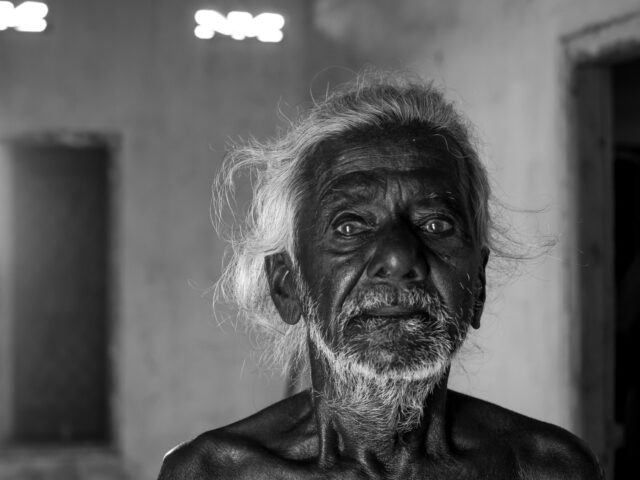
Byron Unmani was an elder of the Veddahs, Sri Lanka’s indigenous people, known as the Wanniyala-a-Aetto or “forest dwellers”. Displaced several times over the years, his community eventually settled along the coast and adapted to a new way of life as fishermen, living off the sea where they once lived off the forest. Today they are known locally as the “Sea Veddahs” of Vaharai. In his reflections, Unmani speaks quietly about these changes and about something he fears may soon disappear: the community’s ancient language.
I met Unmani in Vaharai, where a number of Veddah families lived along the coast. Their ancestors had once lived in the forests, but displacement — including during the war — had forced them to adapt to a new environment. Many had become fishermen and were known locally as the “Sea Veddahs.”
As we sat on the porch of his small house, Unmani spoke about these changes with a mixture of acceptance and sadness. Around us stood several neighbouring houses, built of brick and tile rather than the mud huts I had expected. His daughters wore T-shirts and skirts. He seemed proud that the younger generation now had opportunities he had not known.
Yet there was a quiet sadness when he spoke about language.
“Our ancestors were hunters,” he told me. “We learned Tamil in school. But our own language is different — the hunter’s language.”
The younger generation, he explained, now spoke only Tamil.
“If our language disappears in the next ten years, it would make me very sad.”
At one point he sang a beautiful song for me in his language. As he sang, a small crowd gathered around us. Children watched with curiosity as he spoke into the microphone.
Later he took me by tuk-tuk to meet another nearby Veddah community. There I met another elder, dressed in a more traditional way, with matted hair and an axe resting on his shoulder. The two men sat together and spoke about their communities, switching easily between Tamil and their own language. It was clear that Unmani was respected among them.
These communities lived along the border between Batticaloa and Trincomalee. Though now coastal fishermen, they had once been forest dwellers — hunters who lived from the land. The sea had replaced the forest, but the memory of that earlier life remained.
Postscript
I met Byron Unmani only once, in 2012.
Three months later I returned to give him and his family prints of the photographs I had taken. But I was too late. He had passed away the week before.
At the housing scheme where he had lived, I met his daughter. She remembered me and told me the news. Inside the small one-room house I noticed there was no photograph of him on the wall. I was used to Hindu homes where the deceased are remembered with garlanded portraits placed prominently in the house.
I asked how the Veddahs remembered their dead.
Before leaving, I offered to organise a larger framed portrait of Unmani so that it could be hung in the house. His daughter gladly accepted. It felt like the least that I could do.
Batticaloa
September 18, 2013


Transcript and translations
Language
Subjects discussed
"Our ancestors were hunters"
My name is Byron Unmani. I was born… These things come naturally in Tamil…saying how old you are and things. I was born in 1926. Now I am 86 years old. Today a gentleman has come with his assistant to meet me…to interview me and to take my photograph.
Our ancestors were hunters. We learned Tamil in school. But our own language is different. The hunter’s language is a different language. It doesn’t have a script. It’s disappearing.
And today, our children don’t know that language. They only learned Tamil. They only speak Tamil. That’s why we are now considered Tamils. But we have been hunters for generations.
My mother and father have passed away. They didn’t know Tamil. They spoke only our language. The Veddah language.
As far as I can remember they wore clothes made of fabric. But before that I heard that they used to cover themselves with different parts of the tree. I haven’t seen that myself.
During our time, people knew Tamil and began to speak to others easily. Before that, our people would run into the jungle as soon as they saw a stranger like you! They wouldn’t hang around.
The elders would collect honey from the forest. If they brought any back with them, then the others would eat.
One or two would take the honey into town to sell. They might buy some rice with that money and bring back some to the village.
Otherwise, we would mix the honey with sweet corn and manioc and eat that. These things I know.
We moved to Mavadi Odai from Mankerni because of the cyclone.
Because of the tsunami, we moved from Mavadi Odai to here.
We fish for a living now. We catch fish, dry it and sell it. This is how we lead our life now. This is all I know.
Our way of life is very different from the old days. We are more developed now. We weren’t civilised then. This is the main difference.
I don’t know anything else. Our way of life has changed a lot.
Our girls are modern now. In those days, they wore only a small piece of cloth around their waist and another piece around their neck. That’s it. Now everyone is happy and dresses neatly.
It wasn’t like this in those days. Women would wear the saree but without a blouse.
I don’t miss those days. Actually, I’m glad that I’m alive to see these changes. In those days, we didn’t change.
We learnt these songs from our elders. We used to sing with them.
These songs will live on.
But our children won’t be able to sing them. They won’t be able to speak our language properly.
If our language fades away, I would be upset. It would make me sad.
Leave a comment