The Activist
Dominic Jeeva
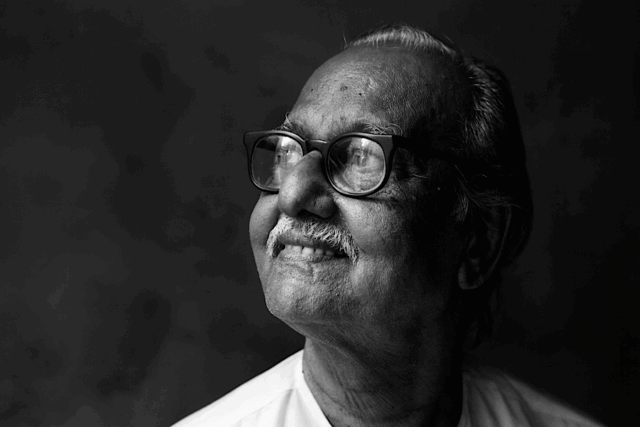
Poet and writer Dominic Jeeva reflects on growing up under Jaffna’s caste system and explains why, despite its many injustices, he still proudly calls himself a Jaffna man.
I took a three-wheeler with my friend Shaseevan to Kotahena, on the fringes of Colombo. I was going to meet one of Sri Lanka’s original activists, Dominic Jeeva. On the way we passed Hindu temples and shops selling Jaffna wares. For a moment it felt like being back in Jaffna.
We arrived at Sri Kathiresan Street, where Mr Jeeva’s small office was located, directly across from a barber shop called Saloon de Shakthi. Knowing about his anti-caste activism, I couldn’t help wondering if this location was deliberate. Mr Jeeva himself comes from the barber caste — one of the lowest rungs in Jaffna’s caste hierarchy — and he still maintains a barber shop in Jaffna.
He had rejected a formal education system that had little interest in educating someone expected to follow his father’s trade. Instead he educated himself, reading magazines and pamphlets from India. In time he began writing and speaking out for the rights of oppressed communities in Jaffna.
Books of poetry and short stories he had written or published through his press, Mallikai Pandhal — the “Jasmine Shed” — were piled high around the tiny office. A photograph of Mr Jeeva with the president hung above his desk. Trophies and certificates filled the shelves and walls. Every inch of space in the dark room was used.
I regretted that my Tamil was not strong enough to read his books, but hoped the interview would help me understand this remarkable man.
Mr Jeeva spoke about growing up with caste, about forbidden love and the limits placed on his life, and about his passion for writing. He was a natural storyteller, acting out moments from his life with sweeping gestures.
Unlike others I had interviewed on the subject of caste, I felt able to ask Mr Jeeva direct questions about what it meant to be treated differently simply because of the family he was born into. I also asked him about the widely held belief that caste discrimination was slowly disappearing.
His answers opened a window onto another world — one far removed from my own privileged Jaffna upbringing.
My final question was simple: after all these experiences, what did he feel about his hometown?
Mr Jeeva’s wrinkled face softened and he smiled.
“Naan Yaalpanathaan,” he said proudly.
“I am a Jaffna man.”
We left him as we had found him, reading quietly by the window.
Colombo
November 27, 2010


Transcript and translations
Language
"I wanted to write"
Then I joined the Joseph Saloon to learn the trade. I was about twelve years old then.
But after that, I couldn’t take how Jaffna’s caste system and its arrogance was destroying my life. I was burning up with so much anger.
Those days, I used to read the magazines, little ones, from South India. The more I read the more I wanted to write. I was around seventeen or eighteen years old. I had this desire to write.
In every incident you could see the Jaffna man’s caste arrogance. He never acknowledged us. Then there were protests for temple access.
In Mavidapuram, leading scholar called Suntharalingam… He stood at the entrance, holding a stick and stopped anyone belonging to the low castes entering the temple. None of the Jaffna scholars were worried about this kind of behaviour. But we stood by the entrance for days.
I am a Christian and that was a Hindu temple. But it was a human right. My aim wasn’t to go in, but my people should be allowed to enter.
As these protests and struggles continued, the Communist Party in Sri Lanka opened a branch in Jaffna. There was a teacher called Karthikesu teaching there at the time. He cared for us and prepared us well. It was during this time that we started to think a little.
We never had a hatred for the Sinhalese. We had nothing bad to say about the Sinhalese. But we couldn’t bear the discrimination in the name of caste by the Tamil man. Right in front of our eyes! Today’s generation won’t understand the pain we went through, in all kinds of ways.
Leave a comment