The Daughter
Dushyanthi Nugawela Wijeyawardena
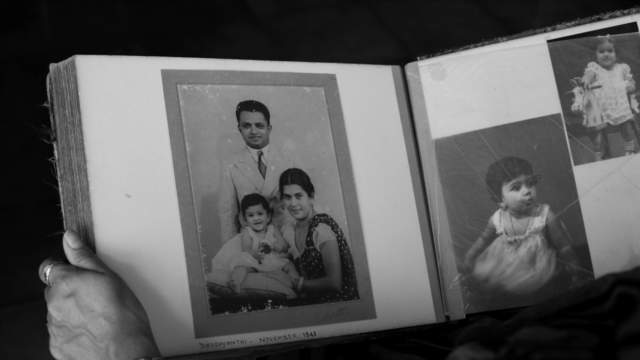
Dushyanthi Nugawela Wijeyawardena reflects on growing up in a household where her father was Buddhist and her mother Christian. Rather than choose for her, her parents encouraged their daughters to respect both traditions and make their own decisions about faith.
When I first spoke to Dushyanthi Nugawela Wijeyawardena on the phone she insisted that I call her “Aunty Dushy”. So when we finally met at her home in Colombo, the conversation quickly settled into an easy familiarity.
Usually I ask interviewees to speak freely before I begin asking questions, and at the end I check if there is anything they would prefer not to have published. Aunty Dushy was open from the start and trusted me to decide what should be included. I hope I have done justice to that trust.
Family is clearly central to her life. As we talked she brought out album after album of photographs that her mother, Louise Erin Nugawela, had carefully assembled over the years. One wall of the house was filled with framed family portraits, alongside objects that connected her to her hometown of Kandy.
Her father, Edward Alexander “Eddie” Nugawela, had been a Buddhist. Her grandfather had served as Diyawadana Nilame of the Sri Dalada Maligawa — the custodian of the Temple of the Tooth — one of the highest honours a lay Buddhist can hold in Sri Lanka.
Eddie Nugawela fell in love with and married a Christian. Rather than choose between traditions, he and his wife encouraged their daughters to respect both beliefs. He often told them that he had come to understand Buddhism through the Christian Sermon on the Mount.
Aunty Dushy repeatedly said she did not want to sound as though she was boasting. But with so many stories tied to an old Kandyan family, it was difficult not to feel the weight of history.
On a second visit she spoke more about her own life. Starting with just three sewing machines in her garage, she built a garment business with the help of her cousin. The company eventually grew to employ more than a thousand workers and supplied international brands including Tommy Hilfiger and GAP.
Like her parents, Aunty Dushy places great importance on family, faith and tradition. Although she has lived most of her life in Colombo, her connection to Kandy remains strong. She spoke proudly about her granddaughters in South Africa continuing the custom of paying respect to elders.
It seemed to confirm her belief that even thousands of miles away, a family can still remain rooted in its traditions.
Colombo
March 5, 2011


Transcript and translations
Language
Subjects discussed
"He learned his Buddhism from Moffat’s translation of the Bible"
I think she was an asset to him. They say behind every successful man, there is a woman. Amma I must say was a real asset to appachchi. Appachchi was seventy-three when he died, but Amma was only fifty, she died of hepatitis because in ‘63 it was something very rare.
My father wasn’t a Christian. His father was a custodian of the Dalada Maligawa, the Temple of the Tooth. But he says he learned his Buddhism from Moffatt’s translation of the Bible.
My grandfather was very disappointed because my mother was a Christian. So I think my father delayed his marriage and he married only once my grandfather had passed away. Though there were a lot of proposals, but I suppose this was his choice.
We were taken to the Maligawa whenever he went, and we did participate in Buddhist activities and my mother was very good — she used to even go down on her knees and worship the… you don’t say priest my father used to always correct me — it’s a Buddhist monk, it’s a monk, not a priest. So he didn’t…so this religion never came between us.
And those days…though he was a minister, the opposition didn’t hark on about these trivial matters of ministers going to church and not like today it was…the government was… it was a very gentle type of government you know. So there was no question of not going to church. He used to go to church… He used to sing hymns. He couldn’t sing in tune and my mother used to nudge him and say don’t sing so loud! And he thought he was singing very well because he used to love to sing.
We used to celebrate Christmas more than Sinhala new year because I feel that in every family the mother’s influence is greater than the father’s. And Santa Claus used to come and stockings used to be hanging out. Then during Easter, they used to hide these Easter eggs and we used to really think that the Easter bunny had come and left the eggs.
And he used to allow nangi and me…we learnt going to CMS, Church Missionary Society, Ladies College . Naturally we did Christianity in school. And once or so I think I’ve carried off the scripture prize also. And we went to the Vajiraramaya on Sundays and we learned our Buddhism there. And he allowed us to choose, what we felt would suit us and what we could believe in.
When my husband died, I was a Buddhist. My mother died three years later. I think that was a turning point and I felt I couldn’t go down on my knees and pray to God and you know… I had decided that I was a Buddhist. But that didn’t interfere, I used to enjoy going and singing hymns and carols, although I didn’t have a good voice. (laughs)
Comments
Leave a comment