The Rathu Mudalali’s Son
Gerald Fonseka
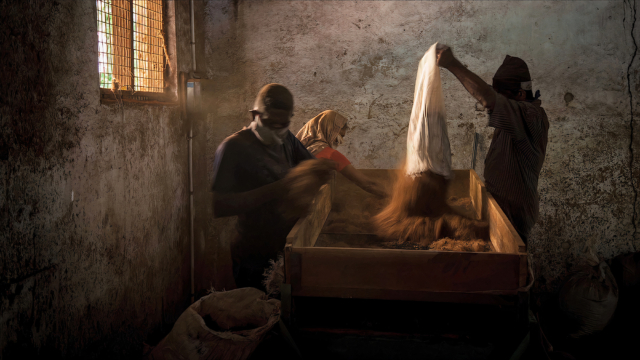
Gerald Fonseka speaks about his late father, known locally as Rathu Mudalali. His father’s ethical treatment of workers on the family’s coconut plantations and fibre mills in the 1950s inspired the son to follow the same example.


Transcript and translations
Language
Subjects discussed
"He used to get into the paddy fields with them"
He was you know…he was identified as Rathu Mudalali. “Rathu” is fair. Even now, you know, when I go to a funeral or a village funeral or somewhere, they will ask me, Rathu Mudalali-da putha nēda? So I had to tell them I am Rathu Mudalali’s putha.
He was involved in coconut business, selling coconuts. He had a fibre mill. And you know we had so many people working here. At that time we didn’t have lorries — they were using carts, bullock carts. The drying place was just behind the house. And the fibre mill was on the other side of the road.
Even when we pluck any…harvest coconuts, we were sent to collect the coconuts with the others. We had enough people to work. But still my father wanted us to, because that was his nature. Even he got involved. Even in the fibre mill, when they were working and drying fibre, he used to go and work with them. That was his way — then only he knew that the people would do a good job. Even I experienced that. Even today I do that. Whenever I get a labourer to do some work here, I go and work with him.
We had a lot of paddy fields just close by. And when we had you know anything to do with paddy, whether it is harvesting or whether it is ploughing or planting, we used to go. My father used to take us. That was one of his principles where… whenever he get the labourers to do, he used to get us also, get involved with the work.
My father was in a different you know…he always used…get us to the paddy field. You know…that is, even he gets into the field. Though he was a businessman, his labourers were working in the field. They used to say, mahathya en epa, right? Mahathya en epa. Still he used to get into the paddy field with them. And both of us, myself and my brother was taken to the field and we were asked to get into the field. Right? He had that principle.
There was a night shift when they worked. You know… if a load of fibre was going to Colombo the next day, the previous night they worked. So we didn’t have electricity at that time. It was those Petromax lamps where halfway I had to go and put kerosene and do all that. That was my father’s nature. He used to send us sometimes to get up at about 11.30 in the night and go to the mill. It was on the other side of the road. But we had to do it.
He was not a strict person, but if he said a person had to come at 8.00, he should be there at 8.00. And you know the whole village… even now they have that feeling, though things are changing. They respected him as their boss.
Even now when they come here they say, ape jī vathune me ge valawwe. We lived here. So we had people to work here. They were in and out of this house during New Year and Christmas. We used to bring them to our house and give them a feed — kiribath or whatever it was — in the kitchen or in the garden. They were free to do it. That is something I have learned from my parents.
Leave a comment