The Graduate
Haniah Sultanbawa
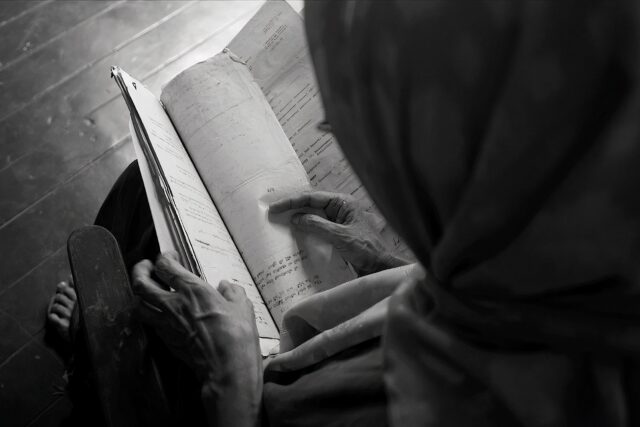
Mrs Haniah Sultanbawa became the first Muslim woman from Sri Lanka’s Southern Province to graduate from a university when she completed her degree at the University of Ceylon in 1960.
She recalls the expectations placed on young Muslim women at the time, the encouragement she received from her father and a missionary teacher, and the challenges she faced as the only Muslim girl studying at Methodist College in Colombo.
Mrs Khalid from Galle Fort, a great source of characters for the project, introduced me to Mrs Haniah Sultanbawa. The first Muslim woman from the Southern Province to graduate from university was too important to miss.
I visited her at her home in Colombo, where she had moved in 1964 after becoming a teacher. Retirement had not entirely taken her away from education. She still tutored students from time to time.
My first impression of Mrs Sultanbawa was her unrelenting modesty. She insisted that she was simply the product of circumstance. She was not particularly intelligent, she said, only someone with a good memory.
Her father encouraged education for his daughters, something that was not widely expected at the time. When the family had to leave Galle Fort, an uncle even gave up his own house so that she could remain close to school and complete her O Levels. Later, when Southlands College stopped offering A Level classes, her teacher Miss Ridge helped arrange her transfer to Methodist College in Colombo.
At Methodist she was the only Muslim girl. She remembered struggling with spoken English and being unfamiliar with things as simple as using cutlery in the hostel dining hall. Some of the wealthier students teased her about the way she dressed and spoke. By her third year, she had become a hostel prefect.
Throughout our conversation she resisted the idea that she had done anything unusual. Only after some coaxing did she acknowledge that perhaps she had helped open the way for other Muslim girls to pursue higher education. Even then she retreated quickly, describing herself as simply “docile”.
Listening to her, I was reminded of my own mother, who was the first woman in her community on the island of Kayts to enter medical school at Peradeniya. The details differed, Tamil Hindu in the north and Muslim in the south, but the structure was recognisable: education negotiated through paternal support, community scrutiny, and the quiet crossing of boundaries that later appear ordinary.
When I called her months after our meeting, Mrs Sultanbawa sounded surprised to hear from me. She had assumed she had “been rejected” from the project. That modesty seemed entirely in character.
Colombo
February 22, 2011


Transcript and translations
Language
Subjects discussed
"It was shocking for a Muslim girl to enter the university. But I did it."
Now we didn’t have minds of our own like the girls these days. We didn’t say… My daughter will say, “I want to be this”. It was not so.
Now I would say that I was lucky that my father was adamant and he gave me the opportunity to carry on with my education. Otherwise I would have been at home and I would have got married to somebody (Laughter). So I would have just taken it. Because you know I didn’t know… At that time… Now, comparatively, I can speak about it. But at that time, that was the way of doing things. So I wouldn’t have complained, I would have just carried on.
Because we were brought up like that. We didn’t have such critical open mind. There was no influence of the TV or radio like that. So we were docile. We just carried on. But circumstances helped me to come up. So that’s something that I am thankful, and the other person is Miss Ridge. Actually she’s a missionary… she was a missionary. My third sister was kept out of school for some time, but she saw to it that she was also brought back to school and now she’s also a teacher. She was a teacher. And so many other Muslim girls she has helped. So she thought I was a… I was good, so she helped me through. So when they closed down the A level class at Southlands, she made arrangements to take us into Methodist College and boarding and all. I was the only Muslim girl.
For me, it was a real struggle. Because I was a poor girl. I was not equipped in dress or anything like that. And my English was also not so good. I could answer ‘yes’ or ‘no’. I couldn’t carry on a conversation. And I couldn’t eat with the fork and spoon. So I actually became a target of… for jokes for them. They used to come behind me and talk about me. Actually, they were taunting me. But I was strong. Any other child I suppose… I tell my children also, even if… these children… if they had faced that situation, they would have cried and gone back home, back to Galle. But later on, by the third year, they made me a hostel prefect and all that. That came through. Then it… At that time, I was stronger.
After I left Methodist College, awaiting results, I was teaching. So I was better equipped economically also to go to the university. Somehow or other, there was some kind of blessing to go through.
For three years, we had a lovely life. Freedom. Not that we did anything wrong, but there was freedom to go out anytime. Go for lectures or stay back, nobody cared.
I wouldn’t say I had a big intelligence or something like that, but I have a good memory. People thought it was a wonderful thing. Because it was the first time a Muslim girl getting out and going to Peradeniya. Because university life was almost taboo those days. It was shocking for a Muslim girl to enter the university. But I did it. So, maybe they were proud, but I thought it was just another step forward.
I made the opening so after that there was such an earnest decision to study. Now it’s just commonplace. Not a wonder like those days.
Comments
Leave a comment