The Warrior Queen
Helga de Silva Blow Perera
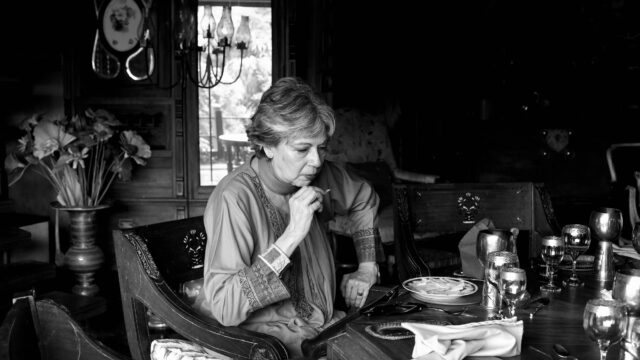
Helga de Silva grew up in the Kandyan family home that later became Helga’s Folly. Part residence, part performance, part “anti-hotel”, she turned the house into a living canvas and a distinctly Sri Lankan domestic world shared with strangers.
When I arrived, tea was served while we waited. Helga descended the staircase in a sari embroidered with the tree of life — designed by her aunt. The performance of self was immediate and deliberate.
The house, originally built by her mother in the 1930s, had moved through phases: elegant family home, mid-century hotel, and finally Helga’s own reinvention. Walls painted in saturated colours. Ceilings transformed into murals. Rooms layered with memory and ornament.
Helga described beginning to paint during a period of personal crisis. “Here’s the paint, there’s the wall,” she tells guests who arrive in distress. Creativity, for her, is therapeutic. The house becomes both refuge and stage.
She resists the term hotel. “It’s a Sri Lankan home,” she insisted. Hospitality here is intimate and curated — drinks on polished silver trays, conversation shaped by mood and theatre. Guests come seeking something different, something excessive, something romantic.
Behind the aesthetic abundance are histories of loss: the deaths of close family members, political lineage, the weight of inheritance. Helga’s self-styling — the “warrior queen” — feels less eccentricity than armour.
The house is less accommodation than autobiography.
Kandy
October 27, 2010


Transcript and translations
Language
Subjects discussed
"I’m very blessed"
(Operatic music)
It’s depending on one’s mood. It’s like topsoil…it just grows.
I get sometimes guests going through a traumatic time and I find painting very, very therapeutic. In fact I was going through a divorce and my father told me… started me on this. He said, “Why don’t you just get he place in Kandy going. You know, just do your own thing”.
So I started and the first room was all black (laughs). Slightly that. And then I just sort of went on. And so I do try and tell guests this, who are going through a sort of trauma. I always say, “here’s the paint, there’s a wall. Why don’t you, you know…just get it all out?” So I like to think all these colours, sort of help people. I mean it’s certainly helped me.
I’m very lucky. I’m very blessed because I have you know both really, if I want. And this is what I want now. And this where I want to be. I like the people around here. And I like the whole romance of it. The whole romance of being in the Kandyan kingdom and things like that.
I was born upstairs. Well I was two days old, shall I put it that way? You know I was born in the Kandy Nursing Home and then I was brought here two days later. My mother was an artist and my father in politics so we had sort of very interesting people you know…always.
My mother designed it in the thirties and then it was totally different. And it was her style and it was very elegant and very lovely. Then it became a hotel in the fifties and everything went into a different mode. You know?
Well I like to feel that I can sort of push everyone’s button, but of course you can’t you know. It’s not for… It’s for guests who want something different, who want something you know… who want to experience something. Have adventures. Have an open mind.
And most of our guests rather like to call and have somebody bring their drinks up on a… we like to do it on a silver tray, hopefully it’s polished! (laughs) You know? The thing is I really don’t think of it as a hotel. I think of it as a home. I think of it as a…What I tell people is it’s a Sri Lankan home. And what we offer here is our Sri Lankan way of life. That is very important to me. It’s not a hotel really. So it’s like running a home.
Comments
Leave a comment