The English Teacher
Ms Rajes Kandiah
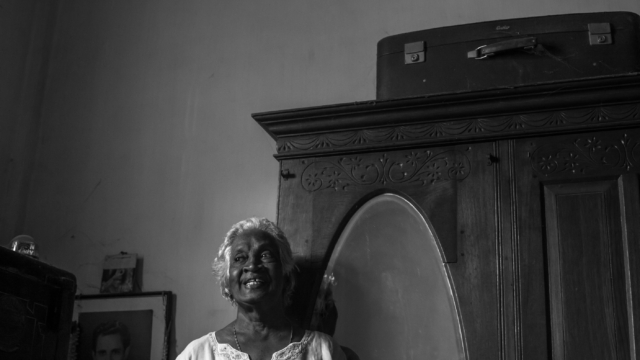
Mrs Kandiah had never been to England, but through the words of her favourite nature poets she could wander through the meadows and hills of the English countryside without ever leaving her home in Batticaloa.
Mrs Kandiah had a remarkable gift for the English language. She relished everything connected with England and Englishness. Though retired from full-time teaching, she continued to tutor young students from Batticaloa.
Much of her time was also spent wandering through landscapes of the imagination — the English countryside she knew so well from poetry.
We sat with her elder sister in the sitting room of their ancestral house while she spoke about this fascination with England. She had just finished helping a local woman prepare an application that required her expertise in English.
In her spare time Mrs Kandiah painted. Her love of art and belief in its healing power had drawn her into community work with children who had experienced trauma. Much of her time was now devoted to projects connected with the Butterfly Peace Garden.
She had never travelled to England. Yet through the words of poets such as Coleridge and Wordsworth, she felt she could visit its landscapes — its meadows, hills and streams — without ever leaving her home thousands of miles away in Batticaloa.
Batticaloa
May 2, 2014


Transcript and translations
Language
Subjects discussed
"To me England was just in my brain all the time"
Sometimes foreigners ask me how come I am sort of so fluent in my English and things like that. I would tell them, I haven’t even gone into the sea here for a swim. I had never left Sri Lanka. And that, of course, was something that impressed the foreigners.
Without leaving Sri Lanka, without even leaving Batticoloa for a long, long time, till I was 20…until I was 20, I hadn’t left Batticoloa at all. I would go to Colombo once, in a way. But still not until I was forty or fifty did I go to England. And when that girl who accompanied me to show me everything, you know, I said, “Well, this is Christopher Wren’s building.” She said, “Aunty, how do you know all this? We in England don’t know at all. About Christopher Wren. About Westminster Abbey.” When I went into Westminster Abbey, it looked as though I had been there for years, almost every day in my life. Things like that were so familiar, all through imagination.
I didn’t go to the countryside, but my memories of this meadow that I set up is still there. Meadows, lambs, streams and you know… the valleys and what I learned in Psalms also. It looked as though I was very, very familiar with it. I still don’t know what it was that made me understand British life so well. British life in the eighteenth century. Jane Eyre’s time, mind you. Now I realise how important imagination is to a child. It goes on through your childhood, well into your adulthood.
I feel more comfortable with English than with Tamil. And of course, it depends on the listener. When I know that the person listening to me doesn’t know a word of English, then somehow I manage to speak good Tamil, because the home language in those days, because my mother didn’t know any English, was Tamil. So once we left school and came home in the evenings, we had double session schools, then. I would come home for lunch, get back and then get back home after playing netball and things like that. It was almost dusk when we returned from the playing field.
We would switch on to Tamil. And that didn’t…wasn’t quite a problem with us kids those days. We were fluent in both languages and we did a lot of English literature taught by English women. So that accounts for all the imagination. And to me, England was just in my brain all the time.
Comments
Leave a comment