The Correspondent
Prince Casinader
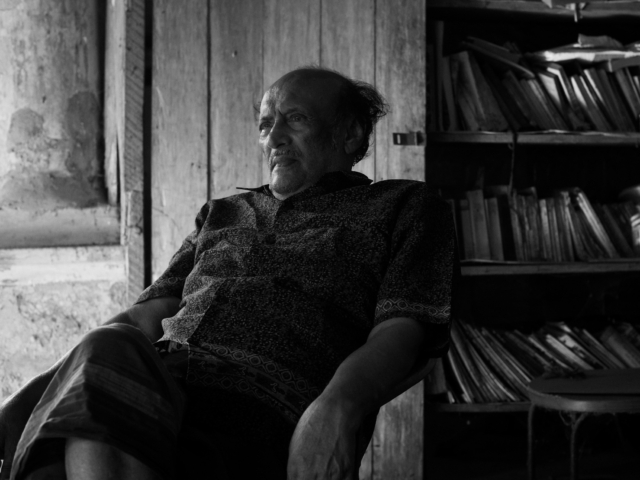
Former parliamentarian and retired principal of Methodist Central College, Prince Casinader is also a long-time correspondent from Batticaloa. He speaks about the singing fish of Batticaloa lagoon, a mysterious natural phenomenon said to be heard most clearly on still full-moon nights, when a listener places an oar in the water and presses the other end to the ear.
For Casinader the singing fish are a symbol of his hometown, a place where Tamils, Muslims and Burghers have long lived side by side. Yet Batticaloa has also endured decades of inter-community conflict between Tamils and Muslims, as well as the devastation of the 2004 tsunami, which destroyed large stretches of the coast and damaged his own home at Dutch Bar. Through his writing and correspondence he continues to reflect on the history, culture and struggles of the region.
Having met Prince Casinader several times over the past few months, I learned that there are two things he does not forgive easily — mispronouncing his name or arriving late for an appointment. I had arrived early for our first meeting but made the mistake of getting his name wrong. Mr Casinader promptly chastised me for it.
Behind his sometimes stern expression — the discipline he instilled as principal of Methodist Central College in Batticaloa is still legendary among his former students — there was also a deep gentleness.
Now in his eighties, he often became emotional during our conversations. His eyes filled with tears as he spoke about his wife, who died shortly after the tsunami, heartbroken by the damage to their cottage at Dutch Bar. He was also moved when I handed him copies of photographs I had taken during earlier visits.
Ill health has meant that Mr Casinader rarely leaves his ancestral home these days. The house, crumbling but still charming, is filled with memories that line its walls and tables. He had been forced to sell the property to pay for heart surgery, but the Batticaloan who bought it — a former student — gave his teacher the right to live there for the rest of his life.
On his desk sat Mr Casinader’s cherished blue typewriter. It was something he said he could not live without. With it he continued his work as Batticaloa correspondent for Lake House and as a defender of human rights. He typed slowly with the index finger of each hand, his face set with determination as he finished a newspaper article or a report on a matter of social justice.
But in recent years the subject that excited him most was something entirely different. As soon as the tape recorder began running he started speaking about the mysterious singing fish of Batticaloa lagoon.
Batticaloa is sometimes called the Land of the Singing Fish. Mr Casinader felt that many Batticaloans had forgotten this remarkable natural phenomenon and had made it something of a personal mission to remind people of it. Through his writing and through speeches at school prize-givings and public events he urged people to value this unusual part of their local heritage.
Over the years he had guided many visitors hoping to hear the sounds for themselves — journalists from Radio Ceylon and even Japanese scientists who came hoping to record them.
I had once searched unsuccessfully in Radio Ceylon’s archives for a recording of the sounds, described by others as “the sweetest treble mingling with the lowest bass” or “like the twanging of a violin string”.
Then, to my delight, I recently learned that a group of Batticaloans — former students of Prince Casinader — had managed to record the singing fish on a full-moon night. With their permission, I have included the sound of the singing fish alongside Mr Casinader’s portrait in the I Am project, in what I hope will be a small tribute to a much admired educator, parliamentarian and correspondent.
Batticaloa
July 10, 2012


Transcript and translations
Language
Subjects discussed
"In clear print it is stated: ‘Land of the Singing Fish’"
It is said to be heard the clearest on a full moon night when there must be absolute quiet. And one has to go by boat, plunge an oar into the water, keep the other end to the ear and listen.
You know, it’s a world respected book called The Encyclopaedia Britannica. And in that book, should you refer to the section on ‘B’, they say Batticoloa. And under Batticoloa, in clear print it is stated ‘Land of the Singing Fish’. I did go when friends come. I take them with a boatman. And they heard it and I’ve heard it.
And that is how I arranged with the Radio Ceylon team and took them out. We went by boat. I said, you have to fulfil the following condition: there will be absolute silence. Best time to hear it will be about 10:00 p.m. Third, there should be absolute silence. And it should be a full moon night.
But when we went out, those fellows were drunk. They were making all the noise in creation and the fish refused to sing. So I had to tell them to come on another date, fulfilling all these conditions. They came and they recorded it. And this Radio Ceylon should be having it in its headquarters or office.
It sounded like a man playing on the keys of a piano. Bass notes, treble notes and various things. Many people who heard it said it sounded like a Jewish harp. Some people said it was akin to somebody with a wet finger rubbing on the rim of a wine glass. But they said there was no harmony in that. It was isolated sounds.
And this is a…this should be almost an international phenomena. You know, people who have heard it include Lord Soulbury, the first governor general of Sri Lanka. There are many foreigners. Lord Holden. And then there are others who have said… When Father Lang, J. W. lang — L-A-N-G — went and taped the sounds, Father Lang gave it to this fellow Jesuit priest to send the tape to his mother in New York to put the… to play the tape and put it down in musical notation.
And that natural history book, which should be in the library, states very clearly… it prints the musical sounds, the notes. Some Japanese ichthyologist came and they did some research, but they couldn’t identify and say that this is the creature that makes the sound. But I know that 90% of the Batticoloa people have not cared to go and listen to this.
Comments
Leave a comment