The Nun
Sister Pushpam Gnanapragasam
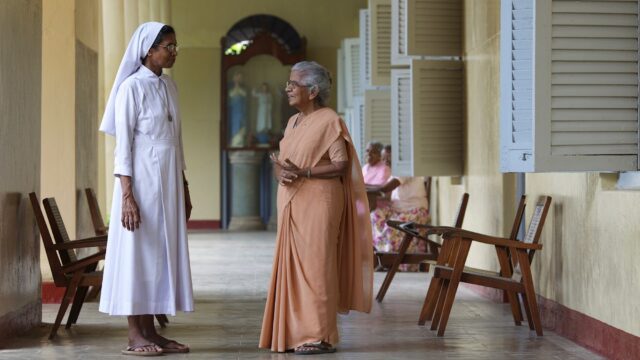
Sister Pushpam Gnanapragasam reflects on Jaffna identity, the arrival of French missionaries in the nineteenth century, and the role Catholic nuns played during the final months of the war.
Passing through large wrought-iron gates from Main Street just outside Jaffna town, I walked towards the imposing buildings of the Convent of the Holy Family.
A young nun greeted me at the door. When I introduced the I Am project she seemed to know immediately who I should speak to. A few minutes later she returned with Sister Pushpam Gnanapragasam — eighty-five years old, tiny in stature, with the warmest smile.
We sat beneath a painting of Father Pierre Bienvenu Noailles, the founder of the Holy Family mission. Sister Pushpam spoke with authority about his life and the history of the convent.
She described the first French missionaries who arrived in Jaffna in the 1860s. Her English was impeccable — and it seemed her French was too. She had translated into English a collection of letters written by Holy Family missionaries between 1862 and 1886, a private manuscript kept in the convent library. She agreed to read aloud an excerpt from one of the letters home.
Listening to her voice, it was easy to imagine these same rooms filled more than a century earlier with French nuns learning to live in Jaffna’s heat, adjusting to an unfamiliar landscape and language, perhaps trying out their first words of Tamil.
Sister Pushpam told me that many of her contemporaries would also have been remarkable elders to speak with, but they were now too frail to communicate. She herself had spent several years in Rome during the worst periods of the conflict in the 1990s. She felt that the stresses of the war had taken a heavy toll on many of the older sisters who remained in Jaffna.
Towards the end of our conversation she spoke about the experiences of younger nuns from the convent during the final months of the war in 2009. She referred to them as “our nuns”, and I asked her what she meant by that phrase. Was there a distinction she was drawing? Her response was thoughtful and candid.
Later, after I had returned to Colombo, a letter arrived from Sister Pushpam. In it she wrote:
“You are actively working to create awareness and to bring about a renewed sense of community … May God, the source of all that is good, bless you and guide you always.”
Inside the envelope she had enclosed a card wishing me blessings for Deepavali, the Hindu festival of lights.
Jaffna
December 31, 2010


Transcript and translations
Language
Subjects discussed
"Jaffna people are always saying “our people”."
You know Jaffna people are always saying…I think you will experience that… “our people”. You don’t mean to say it, you don’t mean to distinguish, but you say our people, invariably you say “our nuns, our priests, our people. Our, our.” I don’t know why, it’s just built in. We just say that.
And it was big joke once when I was young nun and some priests came to talk to…meet us. A few of us were there from Jaffna. And they came and asked for “our nuns”. There were the others too, there was no problem about that at that time, no discrimination or anything, but they came and asked for “our nuns”. So I remember they said, “who are these our nuns?” (Laughs). You know? And then the nuns from Jaffna said…
That “our” is there, no? It’s just there, it’s built in.
If our Sinhala brothers and sisters are…had to go through this, we’ll sympathise with them, we’ll cry with them too. You know if they had to be evacuated like this and they had to undergo all these things. I mean we would be with them. But deep down, it is there. We belong to this place and that place, and that family and this family. At the roots. But we can be one.
By age I would think I’m Sri Lankan, but there are so many issues now. When I was…I told you, after independence, we began to get awakened to a distinct difference and all that.
So I remember in Colombo, when I was studying there, some people were called Tamils without much respect. And ‘Indian Tamils’ and ‘coolies’. And then I began to read in the Sinhala books, the one who climbs the trees, the toddy tappers, are Tamils. So for the Sinhalese readers… little young readers, they showed a man climbing a tree and underneath, ‘a Tamil’.
Comments
Leave a comment