The Reader
S. Thoradeniya
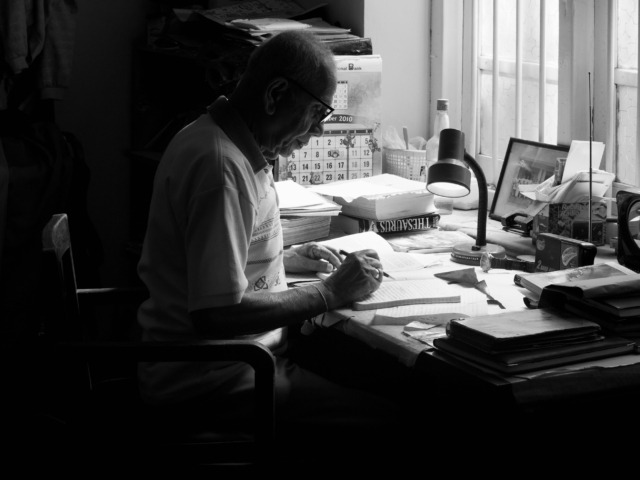
Retired school principal S. Thoradeniya reflects on a lifelong love of reading and a long-held ambition to translate the novel that first captured his imagination as a schoolboy — Jules Verne’s Twenty Thousand Leagues Under the Sea. Encouraged by a Belgian missionary teacher at Ampitiya College during the difficult years of the Second World War, books opened a world beyond the classroom and helped shape his life as a teacher and educator.
Some teachers remain present long after the classroom has disappeared. For Mr Thoradeniya, that figure was Father Augustin Berrewaerts, the Belgian missionary who founded Ampitiya College in Kandy in 1893.
During the Second World War years, scarcity shaped everyday life. Exercise books were rationed. Students wrote their exams on half sheets of paper supplied by the school. Yet Father Berrewaerts insisted that the boys read. He would visit the library, examine the books students had borrowed, and occasionally appear in class to question them about what they had read.
One of those books was Jules Verne’s Twenty Thousand Leagues Under the Sea.
Decades later, when I met Mr Thoradeniya, he had almost completed a translation of the novel — the fulfilment of an ambition first formed as a boy in the seventh standard. It was his second attempt. His first manuscript, along with much of his personal library, had been destroyed by white ants.
Over the years his reading expanded. Writers such as Tolstoy and Bernard Shaw shaped his thinking and influenced his decision to challenge the caste system in his hometown.
As he spoke, Mrs Thoradeniya — herself a teacher — sat nearby listening. Occasionally he referred to her simply as “this one,” smiling. The affection between them was unmistakable.
When he finished translating the first chapters, she was the first person he asked to read them. Her approval mattered most.
“You don’t meet many teachers like Mr Thoradeniya,” someone had once told me. Sitting with him that afternoon, I understood why.
Kandy
November 4, 2010


Transcript and translations
Language
Subjects discussed
"Twenty Thousand Leagues Under the Sea by Jules Verne. Immediately I thought of translating it."
Last year, September 12, I went to Father Berrewaerts’ memorial service to Lewella. While coming back I went to Sarasaviya Book Depot. There I saw this book… This is the book that I saw. Twenty Thousand Leagues Under the Sea by Jules Verne. He wrote this in 1865. An adventure about a submarine. Immediately I bought that and then I thought of translating it.
Now I read this when I was in the seventh standard at Ampitiya College. It was during the Second World War. We felt it extremely difficult. In what ways? Clothing… then food. Travelling… then… even books. We found it difficult to get exercise books for writing and for the exams; we used to get, not a foolscap, but half an exercise sheet, supplied by the principal Father Berrewaerts. Because Father Berrewaerts… was a wonderful man, you see. He used to come to the library and go through the books that we had read. And then suddenly he will come to the class and he would ask a few questions. That encouraged me to read this at that time, when I was in the seventh standard, so can you just imagine?
So that’s the reason why I thought of translating this because I have read some of the translations and many of the translations are not up to standard you see. Now when I translated a chapter or two, so I wanted to get somebody’s opinion about it. And so the closest one is this no? (pointing to Mrs. Thoradeniya.) So I handed it over to her and asked her to read it. So first chapter, second chapter… Then she said, “I’m thrilled with this!” So if she says okay, that means I am satisfied (laughs). So I think it will take about three months to get it published. And if I’m going to be a success, I’ll let you know (laughs).
Comments
Leave a comment