The Fisherman
Seenithamby
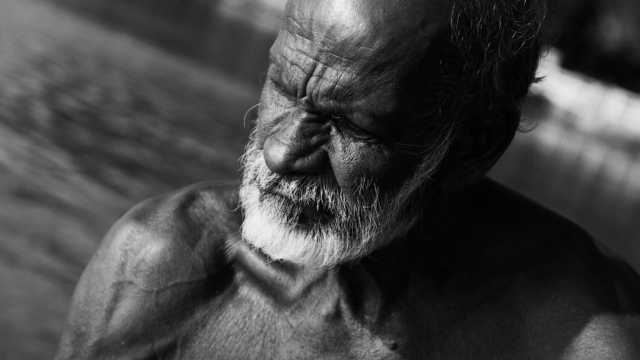
Seventy-one-year-old Seenithamby still throws his net on the Batticaloa lagoon. He reflects on the traditions of lagoon fishing, the father who taught him the craft, and the time he believes he encountered the kadal kanni, part of local fishermen’s folklore.
In Tamil, veeserathu means to throw. Seenithamby, a Batticaloan fisherman, used the word to mean both going fishing and throwing nets. Fishing here depended on the ability to throw nets and once you could no longer do that, you became redundant — an inevitability every fisherman feared. Seenithamby was now seventy-one, but his father had been throwing nets well into his nineties.
I first met Seenithamby by the Batticaloa lagoon. He was finishing work for the day, pulling his boat back from the water. I was too late, so we agreed to meet the next day at his home, a short walk away.
Seenithamby’s father had taught him to fish. “He was a capable man. He didn’t touch anything,” Seenithamby said proudly, meaning he did not smoke or drink — values that had passed down to him. Before going out to fish, Seenithamby still said a prayer.
As Seenithamby rowed out with me as a passenger, he spoke about the kadal kanni, the Tamil name for mermaid. Statues of mermaids can be seen around Batticaloa town and they form part of local folklore. Seenithamby was convinced he had once seen one. Frightened, he had asked his father about it, but his father reassured him that it was quite natural and nothing to be afraid of.
When Seenithamby spoke about fishing with his father, there was a sense of nostalgia for the old ways. But there was also sadness. He felt fishing was no longer the same, with many more fishermen now on the lagoon.
Later he introduced me to his younger brother, Nagalingam, who was sitting by the bank looking out over the water. His arm had given way and he could no longer throw nets. I asked the two brothers to stand together so I could photograph them.
One day Seenithamby too would no longer be able to throw his net. But I hoped that day was still far away, and that he would continue fishing as long as his father had done before him.
Batticoloa
April 19, 2012


Transcript and translations
Language
Subjects discussed
"I used to throw much bigger nets than this. But now I can’t lift them"
I used to throw much bigger nets than this. But now I can’t lift them
We take the thread, put it into the nilaiyaali and twist it around the hand. Then we dip it in the water to soften it. Then we tie the net and rope together. When that’s done. My father and I would go out to work together.
Those days we used wooden boats. Big boats. Bigger than this one. We used nets that were 10 or 12 mulams*.
*A mulam is the distance from the top of the middle finger to the elbow.
Fishing in those days is very different to today. Now if we put the next across the river, blocking the flow, we’ll catch fish. It wasn’t like that those days. The ways have changed now. We don’t use the same gear now. Now we use nylon. There’s a big different between the two. But it was a big process those days. We made the rope ourselves out of yarn.
We took four pieces and made the rope. Then you went out only at a certain time. Now you can fish at any time. You can throw the next at any time.
In the old days, the people used to come home by 10 o’clock. It didn’t matter how much fish was in the lagoon. If we needed fish, we just went there and there the net. That’s it. If we caught too many, then we wouldn’t be able to sell them. And people wouldn’t take them even if you gave them away. Those days if we were going to sea, we would go in the evening. Around 7 o’clock. We’d take a water bottle and some food with us. We’d take all the stuff. A matchbox and a lamp. We used the lamp at sea. Cuttlefish and fish would come to the light. We’d catch them and come back.
My father showed me how to do that. He was a very capable man. He didn’t drink or smoke. Those days they wore the kachai. Also a shirt, a sarong or the vetti. When they went out to fish, they wore only the kachai*.
*A tightly word piece of cloth, worn like undergarment.
People will laugh if they heard this now! He used to tie his hair back. Around the head like this. He was big and strong. He could row the boat by himself, like me. If he didn’t know something, he’d explain it to us. He used to say, “don’t get your feet in the water, the fish could bite.”
Sharks used to come those days. We are always scared of the sea. We say our prayers before we go out. You should have a good heart. You shouldn’t be scared. Then you can do it. You should know what you’re doing. I know where I should throw the net. Some don’t know this.
My father showed me the spots when we went out. They knew it through experience. “Ah here, you can catch them here”. I learned it while I went with them.
These days only a few people did this work. Now everyone does it. That’s why we can’t fish like we did in the old days. Then, if you threw the net once, you’d get enough fish. You find my have to throw it again and again. That’s how it was. If I couldn’t throw the net, I wouldn’t just stop doing anything. I’d go and do something else, like masonry work. Like my father did. This is enough for our needs. I go to work every day. This is the next I use now.
I used to throw much bigger nets than this. But now I can’t lift them. I can only throw this one now.
Comments
Leave a comment